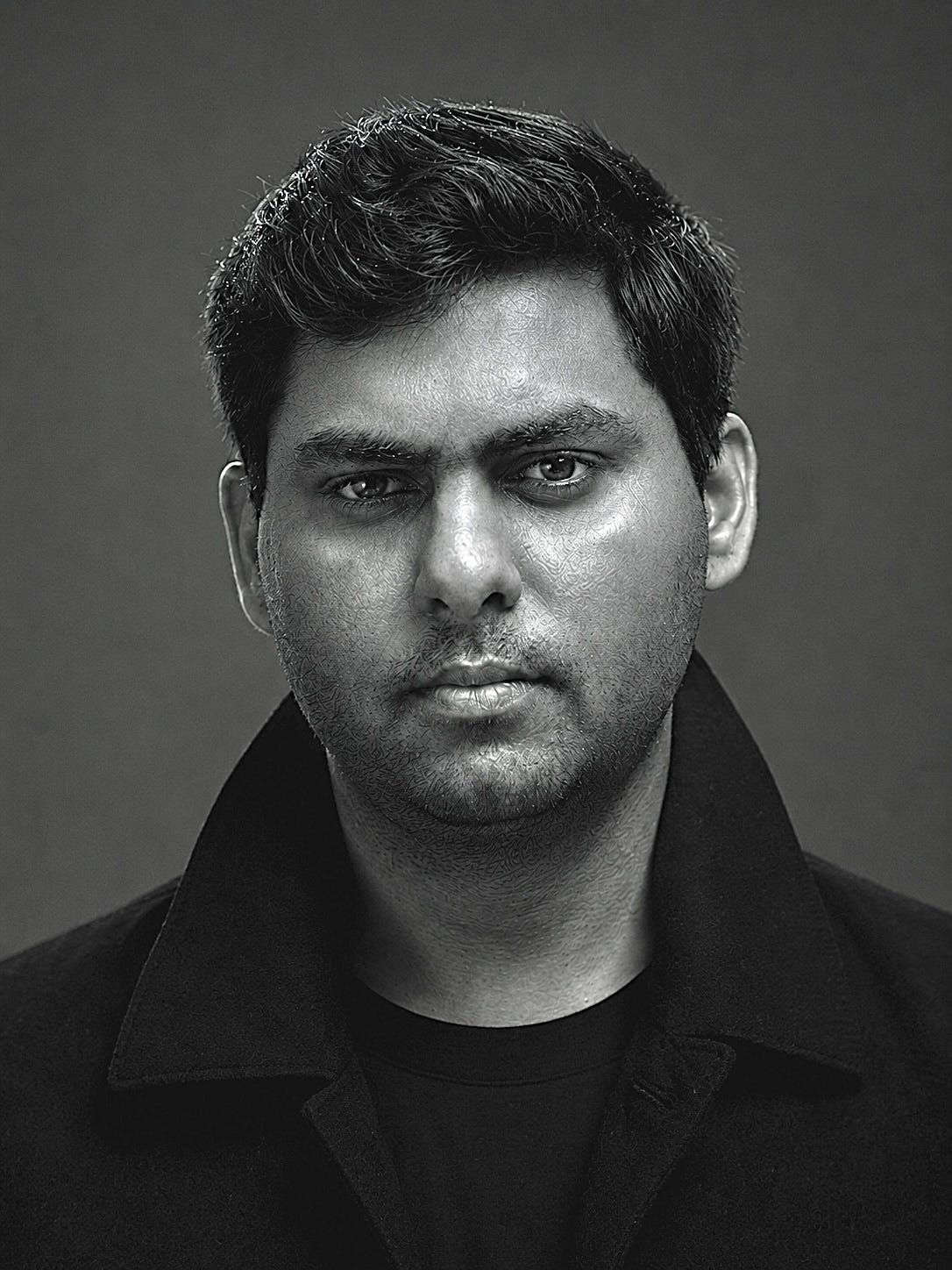
The Record – By Rahul PS
On building from the bottom up — and why that changes everything.


There are seasons of life you do not explain while you are inside them.
Not because there is nothing to say. Usually there is too much. Too many people who made up their minds without asking. Too many versions of a story that were never yours to begin with. Too many people who watched from a distance and decided what they were seeing — without once picking up the phone.
So you go quiet.
Not because you have given up. But because silence, sometimes, is the only form of dignity left.
This is me breaking that silence. Not to correct every record. Not to explain myself to anyone who has already decided. But because I believe in keeping a clean account — of who I am, where I have been, and what I am building now.
Before the fall, there was the climb
I left school after the 10th standard.
No degree. No connections. No safety net. I moved to Mumbai at 18 with one conviction and a level of confidence that, in hindsight, was either extraordinary or completely delusional. Probably both.
I built a digital agency from nothing. Over years, it became something I was genuinely proud of — clients who had every option in the market chose us, and stayed. The work got recognised at places I respected. By my mid-twenties, I had built more than I had imagined when I packed a bag and left Kerala.
I tell you this not to impress you.
I tell you this so you understand what the fall looked like from that height.
2020
I will not tell you the full story of what happened in 2020.
Some things deserve privacy. Some things deserve time. And some things — when you describe them in full — lose the very weight they carried, because people reduce them to a headline instead of reading them as a life.
What I will tell you is this.
In 2020, everything collapsed. Professionally. Personally. Publicly. And when it did, I found out very quickly who was actually there.
The answer was: almost no one.
People I had built with. People I had trusted. Investors, colleagues, clients, friends — people who knew me when I was winning and disappeared when I was not.
That is not bitterness.
That is data.
For three years, I stepped away from building entirely. I was largely alone. I stopped going out. The version of me that had been loud, restless, and relentlessly ambitious went somewhere I could not reach. I did not recognise the person I had become. I am telling you this not for sympathy. I am telling you this as context — because it matters for everything that comes next.
What the silence taught me
When you lose almost everything — your momentum, your identity, your relationships, your sense of what is possible — you have two choices.
You can wait to feel like yourself again.
Or you can start writing.
I started writing.
Not for an audience. Not for content. Not for LinkedIn. Just raw, private documentation. Thoughts at 2am. Decisions I kept second-guessing. Fear I could not say out loud. Patterns I was too close to see clearly. The same questions, surfacing again and again, that I could not answer in the moment.
Over time, those notes became something I did not expect.
They became a record of my inner life. And inside that record, I started seeing things I had never seen before — not just how I was feeling, but why certain situations kept repeating. Why certain types of people kept appearing. Why my language shifted when I was deteriorating versus when I was rebuilding. Why I kept making the same decisions I told myself I would not make.
A single entry captures a feeling.
Years of entries reveal a pattern.
And patterns — when you can finally see them — change what you do next.
That realisation became the foundation of Naomi.
Why this problem is larger than it looks
Most people are not in crisis.
But most people are also not okay.
There is a vast, underserved space between “I’m fine” and “I need clinical help” — where millions of people spend most of their lives. It is the space of quiet exhaustion, recurring confusion, decisions made without clarity, relationships that keep going wrong in familiar ways.
The world is slowly waking up to the scale of it. Depression and anxiety alone cost the global economy around a trillion dollars every year in lost productivity. In India, an estimated 197 million people were living with mental disorders as of 2017 — with a treatment gap ranging from 70 to 92 percent depending on the condition. Meaning: most people who need support are not getting any.
But the statistic that matters most to me is not in any report.
It is the one I lived.
Four years of not building. Of barely existing. Of knowing something was wrong and having no system — no tool, no language, no structure — to help me see it clearly enough to change it.
That gap is what I am building for. Not the emergency room. Not the diagnosis layer. The everyday layer. The decision layer. The place where a person says: something keeps happening in my life, and I cannot see it yet.
What Naomi is — and what it is not
Naomi is not a therapy app.
It is not a mood tracker. It is not a meditation library. It is not a chatbot that starts from zero every time you open it and knows the world better than it knows you.
Naomi is a conversation-based self-reflection platform — built to become more useful the longer you use it.
You talk naturally, the way you would journal or think out loud. Over time, Naomi notices what keeps coming up — the recurring themes, the emotional loops, the decisions that resurface, the language you use when you are clear versus when you are overwhelmed. It reflects those patterns back, in a structured way, so you can see yourself with more clarity than you could alone.
Here is what that looks like in practice.
Imagine you keep writing about a particular relationship — a manager, a collaborator, a family member. You never frame it as a problem. But over weeks, Naomi notices that your energy language drops every time this person appears in your entries. It surfaces that pattern — not as a diagnosis, not as advice, but as a question: you seem to feel differently after interactions with this person. Have you noticed that?
That is the moment Naomi is designed for. Not crisis. Not cure. The moment of seeing — before the pattern becomes your life.
The science behind this design is serious. Research on affect labelling shows that simply naming an emotion changes how the brain processes it. Research on emotional granularity shows that people who can describe their inner states with more precision regulate them better. These are not wellness trends. They are well-replicated findings — and they are the principles Naomi is built on.
I built an early version to test whether this was real. The response to the core interaction was consistently positive — people felt genuinely heard in a way they did not expect from an AI. The early version had technical limitations I already knew about. I used that feedback to rebuild from the ground up. The current version works in real time, and it is a complete redesign based on everything I learned.
The product works because I did not build it from a market insight.
I built it from a lived one.
Why I am the right person to build this
I am a high school dropout who built something significant from nothing, lost it all publicly, spent years in silence most people around me mistook for disappearance, and came back with a product that is the direct result of what that silence taught me.
I did not stumble into wellness because it is a large market.
I am building Naomi because I needed it, and it did not exist.
That is a different kind of motivation. It does not run out when the fundraising gets hard or the metrics disappoint or the market shifts. It runs on something older and more stubborn than ambition.
I am also an operator. I have built businesses, managed campaigns at scale, led teams, navigated acquisitions, and rebuilt from zero more than once. I know the difference between a good idea and a working product. I know what execution actually requires.
Naomi is not a side project. It is not a pivot. It is the thing I have been building toward — without knowing it — for the last several years of my life.
On the people who disappeared
I do not hold grudges.
That is not a performance of generosity. It is simply how I have processed everything that happened.
But I will say this.
When you fail publicly, you discover something about the people around you. And when you rebuild — quietly, steadily, without asking anyone for permission — you discover something about yourself.
You find out what you are made of when no one is watching.
I know what I am made of now.
This is only the first note
I am not going to publish everything at once.
What I will do is write — regularly, honestly — about what I am building, what I am learning, what the research behind Naomi actually says, and what I believe about where AI, self-knowledge, and human decision-making are going.
Some posts will be about the product. Some will be about the science. Some will be about what it is like to build something this personal in public, after years of being very private.
If you are an investor, a researcher, or a builder in this space, I am glad you are here, and I want to hear from you.
If you are someone living inside your own quiet season right now — your own version of the years I just described — I want you to know that the pattern is not permanent.
You can see it. And once you can see it, you can change it.
That is what Naomi is for.
That is what these years were for.